


Nuts are often among the first foods people reconsider when trying to manage their weight, largely because they are both nutrient-dense and relatively high in calories. But the assumption that eating nuts automatically leads to weight gain overlooks a more important consideration: how much is being eaten, how frequently and how it fits into the overall diet.
Does that mean you should avoid them if you’re watching your weight? If you’re trying to manage your weight, nuts can be confusing.
According to nutritionist Mitun De Sarkar, the focus should be on understanding portions and the role a food plays within the wider diet, rather than categorising individual foods as either “good” or “bad”.
“Rather than asking whether one particular food causes weight gain, it’s more useful to look at how much you’re eating, how often you’re eating it and what role that food plays in your overall diet.”
Energy-dense doesn’t mean nutritionally empty
Nuts are energy-dense, meaning they provide a relatively high amount of energy in a small quantity. But energy density and nutrient density are not the same thing.
Take pecans. Along with their naturally rich taste, they provide predominantly unsaturated fats, dietary fiber, plant-based protein and a range of micronutrients.
A serving of pecans is also a good source of fiber, thiamin and zinc, and an excellent source of copper and manganese.
The better question, therefore, isn’t simply “How many calories does this contain?” but “What am I getting from the portion I’m eating?”
The portion can disappear surprisingly quickly
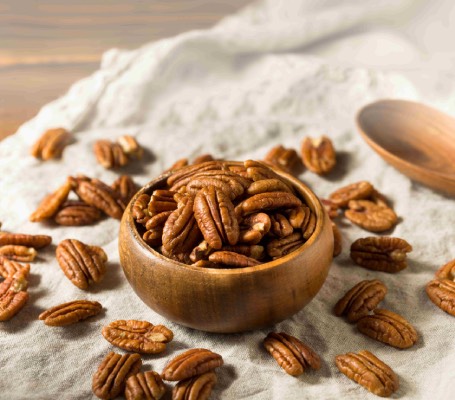
Mitun De Sarkar says that a standard serving of pecans is around 28g – approximately 19 pecan halves.
“Put that amount into a small bowl and it looks quite different from sitting with an open bag and eating without thinking about quantity. That’s why Mitun recommends a simple experiment,” he advised.
At the beginning of the week, divide American Pecans into individual 25–30g portions using small reusable containers or meal-prep bags. You now have a visual reference for what a sensible portion looks like – and a ready-to-go option when you want one.
“Eating directly from a large bag makes it very difficult to judge quantity. Pre-portioning isn’t about restriction. It’s simply a practical way of knowing how much you’ve chosen to eat”, observed Mitun.
Slow down enough to enjoy them
How you eat matters too. Eating while answering emails, scrolling through your phone or watching television can make it surprisingly easy to lose track of what you’ve eaten.
Instead, put your portion into a bowl, step away from the packet and actually taste it. Pecans have a naturally sweet flavour and buttery texture, so there is something to be said for slowing down enough to enjoy them.
So should you avoid nuts if you’re managing your weight?
For most people, the more useful approach is not to fear an individual food but to understand how it fits into the bigger picture.
Portion awareness matters. Overall dietary intake matters. And the nutritional value of what you choose matters too. So if you’ve been avoiding nuts simply because you’ve heard they’re “fattening”, it may be time to reconsider the question.
You don’t need to fear the handful. You just need to know what a handful looks like.