

Now It’s Bringing Men Together Across the UAE.
Following gatherings in Dubai and Abu Dhabi, The Man Cave Project’s founder opens up about the pressures men carry in silence, the unlikely friendships changing lives, and a vision to take the community around the world.
A few years ago, Adil Hussain organised what he thought might be his final barbecue. He had spent years trying to build a community where men could speak openly, but struggled to get them through the door. Financial pressures were mounting, and he was close to giving up.
Then 30 to 40 men showed up. They thanked him for what he was doing and offered to become founding members.
Today, The Man Cave Project has more than 120 members, with thousands of men having participated over the years. It holds four weekly circles across Dubai and Abu Dhabi, averaging around 30 attendees per session.
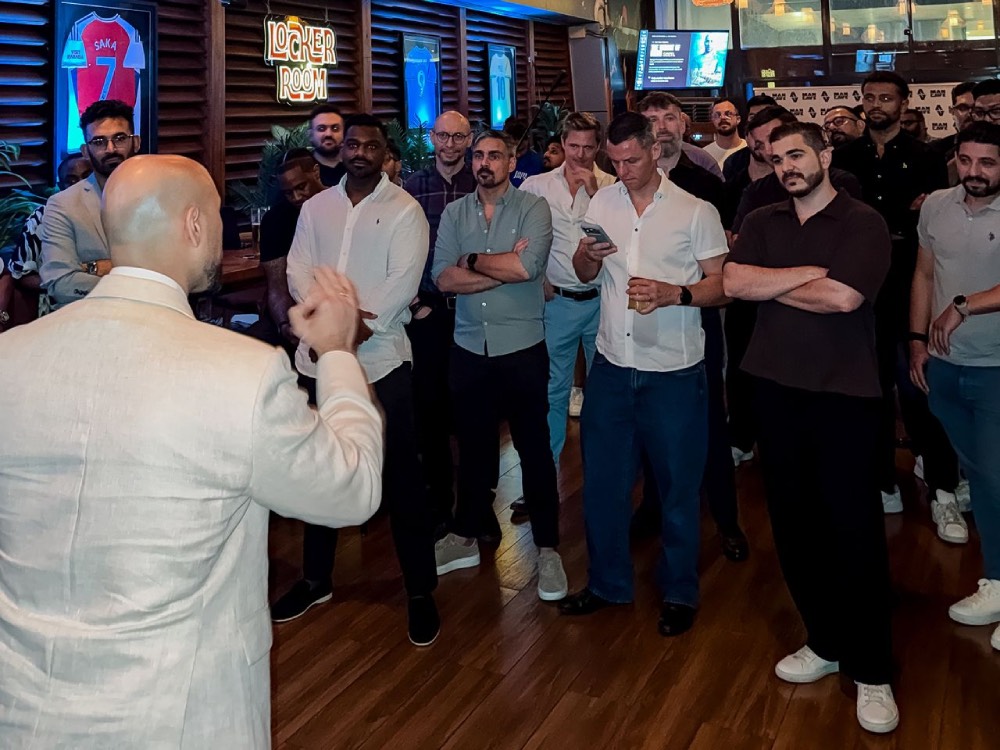
The community has now held Back In The Room gatherings in Dubai on 3 October and Abu Dhabi on 18 October, bringing men together to reflect on how far it has come and explore a future in which members could help lead its next chapter.
For one attendee in Abu Dhabi, the experience was about finding something he hadn’t realised was missing.
“There are good men in Abu Dhabi. I just did not know where they were until Sunday.” The story began in January 2021 with just five men sitting on stools inside a perfume shop. Hussain nervously read a meditation aloud before crumpling his notes in embarrassment.
He knew what it felt like to struggle in silence. Years of suppressing his emotions had left him angry, affecting his relationships and hurting people closest to him. Joining a men’s group forced him to confront parts of himself he had long avoided. For the first time, he felt
able to speak without being judged.
He wanted other men to experience that same freedom.
Originally called Not Just A Man, then Brotherhood DXB and Brotherhood UAE, the initiative eventually became The Man Cave Project.
Building it came at a considerable personal cost. Hussain chose to pursue the project rather than return to a successful UK government career, enduring financial hardship and repeatedly questioning whether it would survive.
Ironically, money is now among the struggles he says men find hardest to discuss.
Behind the appearance of successful careers and comfortable family lives, Hussain describes men quietly battling debt, relationship breakdowns, loneliness and the relentless pressure to provide. Fathers who feel guilty for missing time with their children. Divorced
men questioning whether they will ever be loved again. Men taking on loans they cannot repay, too ashamed to ask for help.
“Some men are really struggling financially and they don’t know how to talk about it,” he says.
And in a city where social calendars can be full, real friendship can be surprisingly hard to find.
“You go to the gym, you might see the same guy for three years and never know his name.”
One member described the isolation of building a life abroad.
“I have lived here eleven years and almost every friendship I have made came through work. Sunday was the first time in a long time I met men I would want in my life for reasons that have nothing to do with my job.”
Hussain recalls a man who called him after reading a newspaper article about the group, devastated after being told by his wife that he was not man enough. Three years later, he is one of Hussain’s closest friends and a core member of the community.
Another man, aged 26, reached out looking for support and attended a comedy night. He has since become a regular, gaining confidence and finding informal mentors among older members.
With participants ranging from 16 to 76 years old, the community brings together men across nationalities, professions and income brackets, many of whom might otherwise never have crossed paths.
The weekly circles begin with meditation before each man has uninterrupted time to speak about what’s happening in his life, without judgment or unsolicited advice. Hikes, fitness activities, workshops and social gatherings help those conversations develop into friendships beyond the room.
For one attendee, the experience challenged his expectations entirely. “I almost did not come. It sounded like either a lads’ club or a therapy group, and I wanted neither. It is neither.”
Hussain has also faced a difficult question: should men have to pay for somewhere they feel comfortable opening up? Memberships help sustain the organisation, but he says men who genuinely cannot afford to attend are welcomed free of charge.
His concerns extend into the workplace, where he believes too many wellbeing initiatives remain little more than awareness exercises. The Man Cave Project has facilitated sessions within organisations including Standard Chartered, Spotify and Omnicom Media Group, but Hussain believes the wider corporate world still has work to do. “It’s not another talk about going to the doctors, and it’s not another talk about how you should speak up. It’s actually creating opportunities for men to talk, not just telling them that they should.”
As another attendee put it: “Every other room I walk into, somebody is selling me something. In here I was being listened to.” His comments follow UAE legislative amendments announced on 8 October decriminalising attempted suicide, shifting the legal approach towards care, prevention and early intervention.
Hussain welcomes the change but believes everyday opportunities for men to seek support are equally important. The Man Cave Project is not therapy or clinical treatment, and participants requiring specialist help are referred to appropriate professionals. Its Abu Dhabi chapter, established in April, is opening doors to new communities. Hussain says the project has partnered with Abu Dhabi Harlequins to facilitate sessions with rugby players, with involvement planned at a junior tournament in November.
He also hopes to address what he sees as a shortage of positive male role models, particularly as young boys encounter potentially harmful messages about masculinity online. Among his ambitions is a Big Brother Academy, training men to mentor boys, alongside a model allowing members to establish and lead their own chapters. Further ahead, he envisions dedicated community spaces and an international membership network connecting cities including Dubai, Abu Dhabi, London, Rome and beyond.
Schools for boys and orphanages also feature in his longer-term aspirations. The project collaborates with The Sisterhood Project, run by Hussain’s wife, Mariah, through joint activities and monthly mixed circles, reflecting his belief that healthier men can build healthier relationships and families. Yet for all the plans to grow, Hussain’s greatest ambition remains the one that brought five men into a perfume shop nearly six years ago: giving men somewhere they no longer feel they have to pretend everything is fine.
“If I could change one misconception about men, it’s that we men don’t feel. Us men, we feel a lot. We feel a lot of emotions. We just don’t know how to say it sometimes.”